
Basic molecular biology and cloning
Primers had been ordered from Built-in DNA Applied sciences. All plasmids, together with self-targeting lentiviral components, PE-PRISM libraries, epegRNA expression plasmids and eVLP plasmids, had been cloned by isothermal meeting utilizing NEBuilder HiFi DNA meeting grasp combine (New England BioLabs, E2621) with DNA inserts from Built-in DNA Applied sciences (eBlocks or gBlocks) or Twist Bioscience (gene fragments with out adaptors) and backbones amplified by PCR with Q5 Scorching Begin high-fidelity 2× grasp combine (New England BioLabs, M0494), except in any other case indicated. For arrayed lentiviral switch plasmids for self-targeting lentiviral components, assemblies utilizing PCR-amplified spine from pSEP308 plasmid80 had been reworked into NEB 5-alpha competent cells (New England BioLabs, C2987). For epegRNA plasmids for transfection, assemblies utilizing PCR-amplified spine from pU6-pegRNA-GG-acceptor plasmid (Addgene, 132777) had been reworked into One Shot Mach1 cells (Invitrogen, C862003). Plasmids had been purified by Qiagen Plasmid Plus 96 miniprep kits (16181), Qiagen Plasmid Plus midi kits (12943) or Qiagen Plasmid Plus maxi kits (12963). Cloning backbones and primer sequences are supplied in Supplementary Desk 1.
Basic mammalian cell tradition situations
HEK293T (ATCC, CRL-3216), N2a (CCL-131), HeLa (CCL-2), K562 (CCL-243) and U2OS (HTB-96) cell strains had been bought from the American Kind Tradition Assortment (ATCC). Gesicle 293T cells had been bought from Takara (632617). HEK293T, Gesicle 293T, HeLa and N2a cells had been cultured in DMEM with GlutaMAX (Gibco, 10569044) supplemented with 10% (v/v) FBS (Gibco, 16000044). K562 and U2OS cells had been cultured in RPMI 1640 medium with GlutaMAX (Gibco, 61870127) and McCoy’s 5A (modified) medium (Gibco, 16600082), respectively, supplemented with 10% (v/v) FBS (Gibco, 16000044). G-CSF-mobilized human CD34+ HSPCs from unidentified wholesome grownup donors (Fred Hutchinson Analysis Heart) had been cultured in X-VIVO-10 (Lonza, 04-380Q) medium supplemented with 100 ng µl−1 human stem cell issue (Peprotech, 300-07), 100 ng µL−1 human thrombopoietin (Peprotech, 300-18) and 100 ng µl−1 human FLT3 ligand (Peprotech, 300-19) at a density of 1 × 10⁶–2 × 10⁶ cells per ml, as beforehand described16. Major mouse fibroblasts had been remoted from tail dissections and cultured in DMEM with GlutaMAX (Gibco, 10569044) supplemented with 20% (v/v) FBS (Gibco, 16000044) and 1× penicillin–streptomycin (Gibco, 15070063), as beforehand described15. Immortalized bronchial epithelial 16HBEge-F508del cells (16HBE14o- cells homozygous for F508del and M470; presents from the Cystic Fibrosis Basis Therapeutics Lab) had been cultured in minimal important medium (Gibco, 11095-072) supplemented with 10% (v/v) FBS (Gibco, 16000044) and 1% penicillin–streptomycin (Gibco, 15070063). Tissue tradition dishes had been pretreated at 37 °C 5% CO2 for two h with LHC-8 basal medium (Gibco, 12678017) supplemented with 1.34 µl mL−1 of seven.5% (v/v) BSA (Gibco, 15260037), 10 µl ml−1 bovine collagen resolution kind 1 (Superior BioMatrix, 5005-100 ML) and 10 µl ml−1 fibronectin from human plasma (Thermo Fisher Scientific, 33016015), as beforehand described17. All cell strains examined unfavourable for Mycoplasma and had been authenticated by their suppliers. All cell strains had been cultured at 37 °C with 5% CO2.
Design of v1 display screen
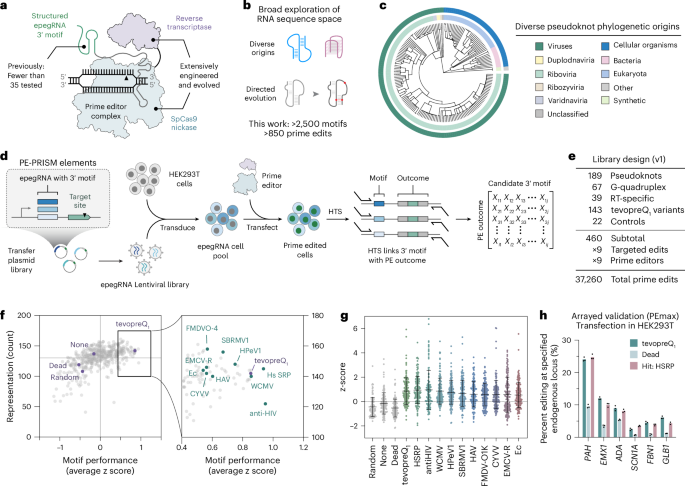
Pseudoknot sequences had been extracted from PseudoBase52. G-quadruplexes had been chosen from beforehand reported sequences or designed in accordance with the sample (G3N1)4, (G3N2)4 or (G3N3)4, through which three-guanine tracts are separated by randomized loop sequences of 1–3 nt55,56,57. RT-specific motifs had been manually designed from subsets of secondary buildings (stem-loop and hairpin motifs) from the murine proline tRNA59, the msDNA RNA–DNA hybrid of the Ec48 retron and the self-priming area of the Tf1 mRNA60. Lastly, all potential single-nucleotide variants of tevopreQ1 had been designed and included within the v1 library. Subsequent, motifs had been filtered to (1) exclude sequences with G+C content material exceeding the vary 20–80%, (2) implement a most pseudoknot size of fifty nt; and (3) take away components with oligo-U tracts ≥ 4 nt that will terminate RNA polymerase III transcription. Together with 5 random controls, closing chosen motif designs (n = 460) had been paired combinatorially with pegRNAs specifying 9 beforehand developed prime edits26,27 and one nontargeting management pegRNA (concentrating on mouse Dnmt1) to reach an inventory of 4,600 epegRNAs. These assembled epegRNAs had been paired with an adjoining artificial goal website (43–44 nt in size); the unfavourable management was paired with a scrambled goal website. Every epegRNA–goal website factor was assigned a novel 10-nt barcode, which was break up into 5-nt halves that flanked the artificial goal website instantly following the U6 terminator. The size of library components was standardized utilizing randomized variable-length linkers with balanced G+C content material and excluded homopolymers, such that inclusion of homology arms (24 nt every) resulted in a uniform library size of 300 nt. Last designs are included in Supplementary Desk 2.
Design of v2 display screen
Motif variants had been generated from 13 prime v1 sequences and tevopreQ1 as follows. On the premise of the anticipated secondary construction (for instance, dot-bracket annotation included within the PseudoBase ref. 52), unpaired nucleotides had been iteratively trimmed from each ends to generate shortened sequences (n = 61) with minimally disrupted secondary buildings. Subsequent, from every maximally trimmed sequence or tevopreQ1 as the start line, focused mutagenesis was carried out to keep up secondary construction as follows: (1) double mutations in paired areas (n = 562); (2) double deletions in paired areas (n = 99); (3) double insertions in paired areas (n = 792); (4) single deletions in unpaired areas (n = 85); (5) single substitutions in unpaired areas (n = 366); and (6) double deletions in unpaired areas (n = 54). Pairing interactions in generated sequences included canonical Watson–Crick and the G•U wobble base pair. Together with 11 unfavourable controls (useless or random variants) and 14 constructive controls (unmodified v1 sequences), the ultimate record of two,044 motif variants was paired with 5 prime pegRNAs from the v1 display screen (concentrating on EXM1, PAH, ADA, SCN1A and FBN1) to generate 10,220 assembled epegRNAs. Randomized, GC-balanced linkers had been put in between the epegRNA and reverse-complemented artificial goal website (45 nt) to end in a uniform size of 246 nt, after which a 12-nt barcode was added. The assembled insert was flanked by 21-nt homology arms for Gibson meeting. Last designs are listed in Supplementary Desk 3.
Design of v3 display screen
Prime variants from the v2 dataset from motif households for Ec (n = 3), FMDVA-2 (n = 11), FMDVO-3 (n = 3), FMDVO-4 (n = 3), HAV1 (n = 8), HPeV1 (n = 15), PhyMV (n = 3), SBRMV1 (n = 16), tevopreQ1 (n = 20), TMEV (n = 3) and WCMV (n = 3) had been included as constructive controls (n = 88). Inside every household, we generated all potential pairwise combos of mutations current within the chosen variants (n = 314 whole throughout all households). We additionally generated combos from three of the highest variants for FMDVA-2 (n = 13), HAV (n = 3), HPeV1 (n = 4), SBRMV1 (n = 9) and tevopreQ1 (n = 16). Together with useless and random unfavourable controls (n = 9), the ultimate record of motifs (n = 453) was paired with 13 prime edits from earlier screens or reviews81 (to generate 5,889 epegRNAs. Every epegRNA was assigned a novel 20-nt barcode, which was break up into 10-nt halves that flanked a 46-nt reverse-complemented artificial goal website. Balancing linkers had been launched between the epegRNA and 66-nt barcode-flanked artificial goal website to have uniform insert size of 258 nt, such that 21-nt cloning homology arms introduced the complete library size to 300 nt. Sequences are listed in Supplementary Desk 4.
Design of v4 display screen
We superior 19 motifs together with n = 9 prime motif sequences from the v3 library, n = 7 parental sequences from the v1 library and n = 3 controls (useless, scrambled and none). From Library ClinVar33, we randomly chosen n = 976 edits after making use of these filters: (1) exclusion of oligo-U tracts of size ≥ 4 nt; (2) most RTT size of 28 nt; (3) most edit size of 1 nt (for insertions and deletions); and (4) minimal 5% reported revealed enhancing effectivity. We additionally included edits from earlier screens (n = 14) and unfavourable management edits utilizing the Staphylococcus auricularis scaffold sequence (n = 10). As earlier than, we combinatorially generated epegRNAs (n = 19,000) incorporating these edits and motifs and appended a variable-length GC-balanced linker and a reverse0complemented goal website (49 nt) flanked by two halves of a novel 16-nt barcode. Flanking 23-nt homology arms resulted in a uniform library of 300 nt. Full sequences are listed in Supplementary Desk 5.
Design of v5 display screen
We took 60 pegRNA sequences from the v4 library and selected six top-performing motifs (eHAV, tevo2.0, HAV, eSBRMV1-A, eFMDVA-2.2 and eFMDVO-4) and n = 4 controls (tevopreQ1, useless tevopreQ1, scrambled tevopreQ1 and no motif). For every pegRNA–motif pair, the tetraloop of the information scaffold was barcoded with ten redundant however distinctive 10-bp sequences, yielding a complete of 6,000 barcoded pegRNAs. The ten-bp sequences, indicated in Supplementary Desk 6, had been inserted in between ‘GTTTAAGAGCTATGCTGGA’ and ‘AACAGCATAGCAAGTTTAAATAAGGCTAGTCCGTTATCAACTTGAAAAAGTGGCACCGAGTCGGTGC’ sequences within the information scaffold. We transduced HEK293T cells with a lentiviral pool encoding the v5 library, transfected the cells with both PEmax or PE7 and harvested each genomic DNA (gDNA) and small RNAs. We reverse-transcribed the RNA utilizing a scaffold-specific primer (oSEP0952) and amplified and sequenced the scaffold barcode area to quantify pegRNA illustration on the RNA stage relative to the corresponding DNA stage. For every pegRNA–motif pair, we averaged measurements throughout the ten barcodes to acquire a normalized estimate of pegRNA abundance. The library was filtered based mostly on having >10 depth-normalized sequencing reads throughout all DNA and RNA samples analyzed, leading to 3,860 barcodes getting used to guage pegRNA abundance. Full sequences are listed in Supplementary Desk 6.
Basic library cloning protocol
All high-throughput screening libraries had been ordered as single-stranded oligo swimming pools from Twist Biosciences and amplified to arrange a double-stranded library utilizing primers oHS0081 and oHS0082 (Supplementary Desk 1) in accordance with beneficial protocols utilizing Q5 Scorching Begin high-fidelity 2× grasp combine (New England BioLabs, M0494) beneath the next situations: preliminary denaturation at 98 °C for 30 s, adopted by 11–13 cycles of 98 °C for 10 s, 68 °C for 30 s and 72 °C for 20 s. Amplified inserts had been purified on MinElute PCR purification equipment (Qiagen 28004). Isothermal meeting was carried out with NEBuilder HiFi DNA meeting grasp combine (New England BioLabs, E2621) utilizing amplified double-stranded inserts (12 ng) and DpnI-treated (New England BioLabs, R0176) PCR-amplified lentiviral spine (50 ng; tenfold molar extra) with incubation at 50 °C for 1 h. Assemblies had been purified utilizing QIAquick PCR purification equipment (Qiagen, 28104) right into a minimal quantity of double-distilled H2O, electroporated into NEB 10-beta Electrocompetent Escherichia coli (New England BioLabs, C3020) in accordance with producer’s directions and grown on carbenicillin-supplemented (50 µg ml−1) Luria–Bertani agar plates at 1,000× protection, based mostly on serial dilution plating. After 12–16 h, switch plasmids had been remoted from scraped colonies with the Qiagen Plasmid Plus maxi equipment (12963).
Lentivirus packaging and transduction in cell tradition
For manufacturing of lentivirus for self-targeting epegRNA constructs, HEK293T cells had been seeded in six-well plates (Corning, 0720083) at a density of 9 × 10⁵ cells per effectively. At 16 h after seeding, cells had been transfected with Lipofectamine 2000 (12 µl; Invitrogen, 11668019) following the producer’s protocol to ship switch plasmid (1,333 ng), pCMV-dR8.2 dvpr (1,000 ng; Addgene, 8455) and pMD2.G (667 ng; Addgene, 12259) in Opti-MEM I reduced-serum medium (250 µl; Gibco, 31985070). The medium was modified 12–18 h after transfection and viral supernatant was collected at 48 h after transfection, centrifuged at 500g for five min to take away particles and filtered by way of 0.45-µm polyvinylidene difluoride (PVDF) filter (MilliporeSigma, SLHVM33RS) and straight used with out additional focus. For PE-PRISM library swimming pools, lentivirus packaging was scaled up 6× in 10-cm dishes for virus manufacturing to make sure enough virus for library protection. Cells had been transduced aiming for an MOI of 0.3 and ≥1,000× protection of transduced cells.
For transduction of HEK293T cells, the cell tradition was supplemented with lentivirus-containing supernatant. For transduction of K562, U2OS, HeLa and N2a cells, spinfection was carried out in six-well plates (Corning, 0720083) with 2 × 10⁶ cells in medium supplemented with lentivirus-containing supernatant and 10 µg ml−1 polybrene (MilliporeSigma, TR-1003-G) with centrifugation at 900g for 90 min at 33 °C and the cells had been transferred to T75 flasks (Corning, 353136) for restoration at 37 °C, 5% CO2 environment. Transduced cells had been passaged after 24 h. To pick for transduced cells, media was supplemented with puromycin at 1 µg ml−1 (InvivoGen, ant-pr-1) at 48 h after transduction and cells had been cultured in selective medium for six days till >95% of reside cells had been BFP constructive, as measured by a CytoFlex S movement cytometer (Beckman Coulter). To quantify transduction effectivity, BFP fluorescence was measured at >72 h after transduction in cells passaged beneath nonselective situations to make sure purposeful MOI < 0.3.
PE by transfection and electroporation for plasmid DNA supply
For PE in pooled PE-PRISM screens, transduced and chosen HEK293T cell libraries had been plated in 15-cm dishes (Celltreat Scientific Merchandise, 229651) at a density of 6 × 10⁶ cells, seeding as many plates as required to make sure ≥1,000× library protection per organic replicate. After 16 h, every 15-cm dish was transfected with a mix of Lipofectamine 2000 (120 µl) and prime editor plasmid (50 µg) in 2 ml of Opti-MEM I reduced-serum medium (Gibco, 31985070), following the producer’s beneficial protocol. Cells had been passaged after 48 h and cultured for 96 h for gDNA extraction utilizing QIAamp DNA blood maxi equipment (Qiagen, 51192) following the producer’s protocol.
For transfection of editors with pooled self-targeting panels in various cell sorts (Fig. 3a,b and Prolonged Information Fig. 5b), transduced HeLa and U2OS cells had been seeded at 2 × 10⁵ cells per effectively in six-well plates (Corning, 0720083) and transfected after 16 h with Lipofectamine 3000 (6 µl; Invitrogen, L3000015), P3000 enhancer reagent (8 µl) and prime editor plasmid (4,000 ng) in Opti-MEM I reduced-serum medium (250 µl; Gibco, 31985070), following the producer’s protocol. Transduced N2a and HEK293T cells had been seeded at 2 × 10⁵ cells per effectively in six-well plates (Corning, 0720083) and transfected after 16 h with Lipofectamine 2000 (10 µl; Invitrogen, 11668019) and prime editor plasmid (4,000 ng) in Opti-MEM I reduced-serum medium (250 µl; Gibco, 31985070), following the producer’s protocol. Transduced K562 cells (200,000 per response, two reactions per organic replicate) had been electroporated in 20 µl of full SE nucleofector resolution supplemented with 1 µg of prime editor plasmid in a 16-well strip of SE 4D-Nucleofector X Package S (Lonza, V4XC-1032) and electroporated (program FF-120) with the 4D-Nucleofector system (Lonza, AAF-1003X); cells had been resuspended in 80 µl of prewarmed medium and transferred into 1 ml of prewarmed tradition in 24-well plates (Corning, 3527). After 72 h, gDNA was collected from HeLa, U2OS, N2a, HEK293T and K562 cells utilizing the QIAamp DNA mini equipment (Qiagen, 51304) following the producer’s protocol.
For arrayed validation experiments, HEK293T cells had been plated in 96-well plates (Falcon, 353075) at a density of 104 cells per effectively and cultured for 16 h. For PE in cells with preinstalled self-targeting lentiviral constructs, cells had been handled with Lipofectamine 2000 (0.5 µl) and prime editor plasmid (200 ng) in Opti-MEM I reduced-serum medium (10 µl; Gibco, 31985070), in accordance with the producer’s protocol. For PE of endogenous genomic targets, cells had been handled with Lipofectamine 2000 (0.5 µl), prime editor plasmid (200 ng), (e)pegRNA plasmid (50 ng) and nicking gRNA (ngRNA) plasmid (15 ng if PE3 was optionally used) in Opti-MEM I reduced-serum medium (10 µl), in accordance with the producer’s protocol. Low-dose transfection situations (Fig. 3d and Prolonged Information Fig. 4d) used 200 ng of prime editor plasmid and a pair of ng of epegRNA plasmid. For twin-PE experiments, cells had been handled with Lipofectamine 2000 (0.5 µl), prime editor PE6c plasmid (50 ng) and each epegRNA plasmids (10 ng every) in Opti-MEM (10 µl). For plasmid transfection in Hepa1-6 cells (Prolonged Information Fig. 8f), cells had been seeded in 96-well plates at a density of 104 cells per effectively and cultured for 16 h earlier than treating cells with Lipofectamine 2000 (0.5 µl), prime editor plasmid (200 ng) and (e)pegRNA plasmid (50 ng) in Opti-MEM I reduced-serum medium (10 µl), in accordance the producer’s protocol. Cells had been harvested 72 h after transfection, tradition medium was eliminated and cells had been lysed in 100 µl of lysis buffer (10 mM Tris-HCl pH 8.0, 0.05% SDS and 25 µg ml−1 proteinase Okay) with incubation at 37 °C for 1 h, adopted by 55 °C for 30 min, and the ensuing crude combination was used straight as enter for focused amplicon sequencing.
Isolation of small RNAs for v5 display screen
Small RNAs for every replicate had been remoted utilizing the Qiagen RNeasy Maxi equipment (Qiagen, 75162) with the next modifications particular to small RNA isolation; cell pellets had been lysed utilizing 10 ml of QIAzol lysis reagent (Qiagen, 79306) and incubated at room temperature for five min. Subsequent, 2 ml of chloroform was added and tubes had been shaken for 15 s by hand adopted by incubation at room temperature for 3 min. Tubes had been centrifuged at 5,000g for 15 min at 4 °C. The higher aqueous section was transferred to a brand new tube. Then, 1.5 volumes of 100% ethanol had been added and combined completely by vortexing. Your complete pattern, together with precipitate, was transferred to an RNeasy Maxi spin column. From this level ahead, we adopted the producer’s protocol for the Qiagen RNeasy Maxi equipment.
Excessive-throughput sequencing (HTS) of PE-PRISM screens
gDNA from every replicate was subjected to a primary spherical of PCR (PCR1) utilizing Q5 Scorching Begin high-fidelity 2× grasp combine (New England BioLabs, M0494L) to amplify the built-in lentiviral cassette and append sequencing adaptors. Every 50-μl response contained as much as 5 μg of gDNA. Primer sequences are supplied in Supplementary Desk 1. PCR1 merchandise had been purified utilizing the QIAquick PCR purification equipment (Qiagen, 28104) and a pair of μl (corresponding to five–10 ng) of purified DNA was used as enter for a second PCR (PCR2), which included distinctive pattern indices and movement cell adapters. Last PCR merchandise had been bead-purified with a 0.7× ratio of solid-phase reversible immobilization beads, assessed for high quality utilizing a TapeStation Excessive-Sensitivity D1000 ScreenTape assay (Agilent) and quantified with the Qubit double-stranded DNA (dsDNA) high-sensitivity assay equipment (Invitrogen, Q33231). For screens v1–v4, libraries had been then sequenced with a customized Read1 primer (oHS0139) on an Illumina MiSeq, Illumina NextSeq or Aspect Biosciences AVITI platform for 190 cycles for the R1 learn, eight cycles for the i7 index learn and eight cycles for the i5 index learn. For display screen v5, DNA libraries had been sequenced with a customized Read1 primer (oSEP0488) on an Illumina MiSeq for 26 cycles for the R1 learn, eight cycles for the i7 index learn, eight cycles for the i5 index learn and 80 cycles for the R2 learn. RNA libraries for display screen v5 had been sequenced with out customized primers on an Illumina MiSeq for 35 cycles for the R1 learn, eight cycles for the i7 index learn, eight cycles for the i5 index learn and 70 cycles for the R2 learn. Reads had been demultiplexed with Bases2Fastq (Aspect Biosciences) or ‘generate FASTQ’ evaluation module (Illumina). For additional demultiplexing of particular person components, reads had been separated into particular person FASTQ information by alignment to a corresponding member of the library utilizing Bowtie2 (ref. 82) and trimming to exclude scaffold bases. Modifying outcomes for every library factor had been analyzed utilizing CRISPresso2 (ref. 83), as described beneath. Uncooked knowledge for PE-PRISM screens are included in Supplementary Tables 2–6.
HTS for arrayed experiments
Goal amplicon sequencing was carried out as beforehand described2. Briefly, PCR1 utilizing primers containing Illumina sequencing adaptors and concentrating on the genomic locus of curiosity (primer sequences and modifications in Supplementary Desk 1) was templated with 1 µl of cell lysate utilizing Phusion U inexperienced multiplex PCR grasp combine (Thermo Fisher Scientific, F564L) beneath the next situations: 98 °C for 30 s, adopted by 30 cycles of (98 °C for 10 s, 58–68 °C (optimized experimentally) for 20 s and 72 °C for 30 s), with a closing extension at 72 °C for 1 min. PCR2 to append distinctive Illumina barcodes was carried out with 1 ml of PCR1 as template beneath the next situations: preliminary denaturation at 98 °C for 30 s, adopted by seven cycles of 98 °C for 10 s, 61 °C for 20 s and 72 °C for 30 s), with a closing extension at 72 °C for 1 min. PCR2 amplicons from the identical goal had been pooled and purified utilizing a QIAquick gel extraction equipment (Qiagen, 28704); eluted libraries had been quantified utilizing a Qubit dsDNA high-sensitivity assay equipment (Invitrogen, Q33231), sequenced by single-end sequencing with the AVITI sequencing equipment Cloudbreak Freestyle low output (Aspect Biosciences, 860-00011) or MiSeq 300 v2 equipment (Illumina, MS-102-2002) for 150–300 cycles for the R1 learn, eight cycles for the i7 index learn and eight cycles for the i5 index learn. Reads had been demultiplexed with Bases2Fastq (Aspect Biosciences) or ‘generate FASTQ’ evaluation module (Illumina).
Evaluation of PE outcomes
Demultiplexed sequencing reads had been aligned to a reference sequence utilizing CRISPResso2 (model 2.2.10)83 in batch evaluation mode. For all analyses, the discard_indel_reads parameter was set as ‘TRUE’, the q parameter set as ‘30’ and the expected_hdr_amplicon_seq supplied because the amplicon sequence containing the meant enhancing consequence. The quantification window coordinates (‘-qwc’) had been set to minimally embody the pegRNA nick website, the ngRNA nick website (if relevant), the useless sgRNA putative nick website (if relevant; Fig. 3f and Prolonged Information Fig. 6f) and the tip of the prolonged 3′ flap generated by reverse transcription. The frequency of PE with out indels was calculated as (nondiscarded reads aligning to HDR amplicon)/(whole reads aligning to all amplicons) and is known as ‘enhancing’ all through. The frequency of indels was calculated as (whole discarded reads)/(whole reads aligning to all amplicons).
For evaluation of pooled PE-PRISM screens to determine prime components, uncooked knowledge had been filtered to exclude library components that had dropped out (< 50 reads) and components that confirmed undetectable enhancing (< 5 reads). For every distinctive mixture of motif, goal protospacer and prime editor, we computed a z rating to normalize enhancing outcomes and account for variations in absolute enhancing share throughout these variables. Common z scores for every motif had been calculated throughout occurrences all through the library dataset and organic replicates.
Chemically synthesized gRNA era and in vitro transcription
Artificial epegRNAs had been ordered from Built-in DNA Applied sciences and contained 2′-O-methyl modifications on the first three and final three nucleotides and phosphorothioate linkages between the three first and final three nucleotides. Artificial ngRNAs had been ordered from Synthego and contained 2′-O-methyl modifications on the first three and final three nucleotides and three′-phosphorothioate linkages between the primary three and final two nucleotides.
Prime editor mRNA was generated by in vitro transcription as beforehand described2. Briefly, a linear in vitro transcription substrate was ready by PCR amplification with primers that repaired an inactive T7 promoter and put in a 119-nt poly(A) tail from a plasmid template utilizing NEBNext high-fidelity 2× PCR grasp combine (New England BioLabs, M0541). The PCR product was purified utilizing QIAquick PCR purification equipment (Qiagen, 28104) and in vitro transcribed with HiScribe T7 high-yield RNA synthesis equipment (New England BioLabs, E2040) following the producer’s protocol with two modifications: (1) cotranscriptional capping with CleanCap reagent (Trilink, N-7113) and (2) full substitution of N1-methylpseudouridine-5′-triphosphate (Trilink, N-1081) for uridine triphosphate. Reactions had been incubated at 37 °C for two–4 h, handled with DNase I (New England BioLabs, M0303), purified on a Monarch spin RNA cleanup equipment (T2050), reconstituted in nuclease-free water and saved at −80 °C.
Electroporation of RNA in mouse fibroblasts, 16HBEge cells and HSPCs
Electroporation of human main CD34+ HSPCs from wholesome donors was carried out as beforehand described16. Cells (200,000 per response) had been washed as soon as with 1 ml of PBS and electroporated in 20 µl of full P3 nucleofector resolution (Lonza, V4XP-3032) supplemented with 1 µg of PEmax mRNA, 180 pmol of epegRNA and 120 pmol of ngRNA. The cell–RNA combination was transferred to a 16-well strip of P3 4D-Nucleofector X Package S (Lonza, V4XP-3032) and electroporated (program DS-130) with the 4D-Nucleofector system (Lonza, AAF-1003X). Cells had been suspended in 80 µl of prewarmed development medium and incubated for 72 h.
Electroporation of Atp1a3 E815K mouse main fibroblasts was carried out as beforehand described15. Cells (200,000 per response) had been dissociated with TrypLE Categorical Enzyme (Gibco, 12605036), washed as soon as with 1 ml of PBS and resuspended in 20 µl of full P2 nucleofector resolution (Lonza, 197189) supplemented with 1 µg of PEmax mRNA, 90 pmol of epegRNA, 30 pmol of ngRNA and 30 pmol of useless sgRNA. The cell–RNA combination was transferred to a 16-well strip of P2 4D-Nucleofector X Package S (Lonza, 197189) and electroporated (program DS-150) with the 4D-Nucleofector system (Lonza, AAF-1003X). Cells had been suspended in 80 µl of prewarmed development medium, transferred into 1 ml of prewarmed tradition in 24-well plates and incubated for 72 h.
Electroporation of 16HBEge-F508del immortalized epithelial cells was carried out as beforehand described17. Cells (200,000 per response) had been dissociated with TrypLE Categorical Enzyme (Gibco, 12605036), washed as soon as with 1 ml of PBS and resuspended in 20 µl of full SG nucleofector resolution (Lonza, 197175) supplemented with 1 µg of PEmax mRNA, 90 pmol of epegRNA, 30 pmol of ngRNA and 30 pmol of useless sgRNA. The cell–RNA combination was transferred to a 16-well strip of SG 4D-Nucleofector X Package S (Lonza, 197175) and electroporated (program CM-137) with the 4D-Nucleofector system (Lonza, AAF-1003X). Cells had been suspended in 80 µl of prewarmed development medium, transferred into 500 µl of prewarmed tradition in 24-well plates and incubated for six days. On day 4, cells had been washed with 200 µl of PBS and incubated with recent development medium.
Prime editor protein expression and lipofection of HEK293T CFTR F508del cells
Recombinant PEmax with a C-terminal noncleavable 8×His tag was reworked into E. coli BL21 Star (DE3) (Thermo Fisher Scientific, C601003). Single colonies had been picked into 5 ml of Terrific Broth (TB) medium and incubated at 37 °C for 16 h with steady shaking at 220 rpm. The in a single day cultures had been diluted 1:50 in 250 ml of TB medium and incubated at 37 °C with steady shaking at 220 rpm till an optical density of 0.5–1.0. The cultures had been cold-shocked on ice for 1 h, induced with a closing focus of 0.8% rhamnose (w/v) and shaken in a single day at 220 rpm at 16 °C for twenty-four h. Cultures had been centrifuged at 5,000g and the cell pellets had been resuspended in 25 ml of lysis buffer (20% glycerol, 100 mM Tris-HCl pH 8.0, 5 mM TCEP and 1 M NaCl supplemented with two tablets of cOmplete EDTA-free protease inhibitor cocktail (Roche, 11873580001) and 1:1,000 DNase I resolution (Thermo Fisher Scientific, 90083)). Cells had been lysed by sonication (3% energy, 6 min in whole; 3 s on, 6 s off; Qsonica CL-334 tip with Fisher Scientific FB705 energy module) at 4 °C on ice and clarified by centrifugation at 18,000g for 30 min at 4 °C.
To purify PEmax, clarified lysates had been incubated with 2.0 ml of HisPur Ni-NTA resin (Thermo Fisher Scientific, 88221) and 40 mM imidazole for two h at 4 °C. The Ni-NTA resin was then loaded onto gravity movement columns (G-Biosciences, 82021-346), earlier than washing twice with 10 ml of wash buffer (20% glycerol (w/v), 100 mM Tris-HCl pH 8.0, 5 mM TCEP and 1 M NaCl) and as soon as with 5 ml of size-exclusion buffer (200 mM NaCl, 1 mM TCEP, 10% glycerol and 50 mM Tris-HCl pH 7.5). The protein was eluted in size-exclusion buffer with an imidazole gradient (4 1,000-μl fractions at 100–400 mM). Pure protein fractions had been concentrated (Amicon Extremely Centrifugal filters, 100-kDa molecular weight cutoff (MWCO); Millipore, UFC910008) and analyzed on NuPAGE Bis–Tris mini protein gels, 4–12%, 1.0–1.5 mm (Invitrogen, NP0321BOX) utilizing the Pierce BCA protein assay equipment (Thermo Fisher Scientific, 23225) and Fast Begin BSA normal set (BioRad, 5000207) to quantify protein focus.
HEK293T cells bearing the CFTR F508del mutation had been seeded at 5 × 10³ cells per effectively in 96-well plates 18–24 h earlier than transfection. Instantly earlier than transfection, the medium was changed with Opti-MEM I reduced-serum medium (100 µl; Gibco, 31985070). Prime editor protein (4 pmol), epegRNA (8 pmol), ngRNA (0.5 pmol) and useless sgRNA (0.5 pmol) had been incubated with Cas9 Plus reagent (1.0 µl) and CRISPRMAX reagent (0.9 µl; Invitrogen, CMAX00015) in Opti-MEM I reduced-serum medium (10 µl; Gibco, 31985070) and delivered to cells following the producer’s beneficial protocol. At 12 h after transfection, one other 100 µl of full medium was added. Cells had been cultured for 72 h and harvested for HTS.
eVLP manufacturing and transduction
PE-eVLPs had been produced as beforehand described67. Gesicle 293T cells had been plated in T75 flasks (Corning, 353136) at a density of 5 × 10⁶ cells per flask. After 18 h, a mix of plasmids was transfected with jetPRIME transfection reagent (Polyplus 101000001), following the producer’s protocol, to ship plasmids expressing VSV-G (400 ng; Addgene, 8454), wild-type MMLV Gag–Pol (2,813 ng; Addgene, 35614), Gag–COM–Pol (2,000 ng; Addgene, 211373), Gag–P3–Pol (422 ng; Addgene, 211374), P4–PE (422 ng; Addgene, 211375), COM-epegRNA (3,520 ng; Addgene, 211376) and COM-ngRNA (880 ng). After 48 h, supernatant was collected, centrifuged at 500g for five min and filtered by way of a 0.45-µm PVDF filter (MilliporeSigma, SE1M003M00).
For cell tradition transduction, 5× PEG-it virus precipitation resolution (System Biosciences, LV825A-1) was added to precipitate eVLPs at 4 °C for 18 h, eVLPs had been pelleted at 1,500g for 30 min at 4 °C and resuspended in Opti-MEM I reduced-serum medium (Gibco, 31985070) at 100× focus (100 µl from preliminary 10 ml of medium); all cell tradition experiments had been carried out with eVLPs concentrated uniformly as above to straight evaluate PE-eVLP efficiency per quantity transduced. Goal cells had been plated at 30,000 cells per effectively in 48-well plates (Corning, 356509) and PE-eVLPs had been added on to the medium 18 h later. Cells had been harvested 72 h after transfection and gDNA was remoted by crude lysis, as described above for arrayed validation experiments.
To organize eVLPs for in vivo injections, PE-eVLPs had been ultracentrifuged (SW28 rotor, Optima XPN Ultracentrifuge, Beckman Coulter) at 26,000 rpm (141,000g for an rAV of 118.2 mm) for two h at 4 °C over a 20% (w/v) sucrose in PBS cushion resolution. The eVLP pellet was hydrated in PBS for two h at 4 °C at 3,000× focus after which centrifuged once more at 1,000g for five min to take away particles on a fixed-angle tabletop centrifuge. Concentrated eVLPs had been saved at 4 °C for as much as 7 days earlier than use. Lentivirus-containing expression constructs for eGFP:KASH was produced for coinjection with eVLPs as a marker of transduction as beforehand described67.
LNP formulation and characterization
LNPs had been ready utilizing a microfluidic mixing system84. The ethanol section was generated by dissolving OF-02 ionizable lipid (Cayman Chemical substances, 37652), 1,2-dioleoyl-sn-glycero-3-phosphoethanolamine (DOPE, Avanti Analysis, 850725), ldl cholesterol (Sigma-Aldrich, C8667) and 1,2-dimyristoyl-sn-glycero-3-phosphoethanolamine-N-[methoxy(polyethylene glycol)-2000] ammonium salt (C14-PEG2000, Avanti Analysis, 880150) at a molar ratio of 35:16:46.5:2.5 (OF-02:DOPE:Chol:C14-PEG2000). The aqueous section consisted of a ten mM citrate buffer containing the specified RNA cargo (mRNA, epegRNA or ngRNA). The ethanol and aqueous phases had been mixed at a 1:3 ratio utilizing syringe pumps, yielding a closing mRNA focus of 0.15 mg ml−1.
Formulations had been dialyzed in a single day at 4 °C towards 1× PBS utilizing a dialysis cassette (20-kDa MWCO; Thermo Fisher Scientific, 66003). After dialysis, LNPs had been concentrated at 4 °C with Amicon Extremely centrifugal filters (100-kDa MWCO; Millipore, UFC210024). Complete RNA focus within the resultant LNP resolution was measured by Stunner (Unchained Labs). LNPs had been saved frozen in a ten% sucrose resolution at −80°C till additional use.
In vitro transfection of LNPs
Hepa1-6 cells (ATCC, CRL-1830) had been seeded 24 h earlier than transfection in 48-well poly(D-lysine)-coated plates (Corning, 356509) at a density of 30,000 cells per effectively in 300 µl of DMEM with GlutaMAX (Thermo Fisher, 10566016) supplemented with 10% FBS. PE-LNPs had been ready at 50 ng per effectively (1:0.9:0.1 mRNA-LNP:epegRNA-LNP:ngRNA-LNP by whole RNA focus) and incubated for 10 min at 37 °C with recombinant apolipoprotein E3 (7 µg ml−1; R&D Programs, 4144-AE). A complete of fifty µl of the PE-LNP combination was then added to every effectively. Then, 72 h after transfection, tradition medium was eliminated and cells had been washed as soon as with 1× PBS. Cells had been lysed in 100 µl of lysis buffer (10 mM Tris-HCl pH 8.0, 0.05% SDS and 25 µg ml−1 proteinase Okay) and incubated for 1 h at 37 °C. Lysates had been then heat-inactivated at 80 °C for 30 min and used straight for HTS library preparation.
Animal use
Timed pregnant C57BL/6J mice (Charles River Laboratories, 027) and grownup C57BL/6J mice (000664) had been housed in services at 20–22 °C and 30–50% humidity on a 12-h gentle–darkish cycle with advert libitum entry to straightforward food regimen and water. All mouse protocols had been authorized by the Broad Institute Institutional Animal Care and Use Committee (D16-00903; 0048-04-15-2).
LNP administration to mice and tissue processing
LNPs had been administered to six–7-week-old, feminine C57BL/6 J mice by way of RO injections. Mice had been anesthetized with 4% isoflurane. After induction, the correct eye was gently protruded and an insulin syringe was inserted into the retrobulbar sinus. The LNP resolution (1.7 mg kg−1 whole RNA dose; 1:0.9:0.1 mRNA-LNP:epegRNA-LNP:ngRNA-LNP by whole RNA focus) was then slowly injected. Instantly following injection, one drop of 0.5% proparacaine hydrochloride ophthalmic resolution (Patterson Veterinary, 07-892-9554) was utilized to the attention for analgesia.
Mice had been killed by CO2 asphyxiation 1 week after LNP injection and perfused with 1× PBS by way of the correct ventricle. For gDNA extraction and downstream HTS pattern preparation, bulk tissues from mice had been remoted and minced with scissors. gDNA was remoted in technical triplicate from the minced tissue utilizing the DNAdvance equipment (Beckman Coulter, A48705) in accordance with the producer’s directions and the purified gDNA was used as enter for HTS library preparation, as described above.
Off-target enhancing evaluation
Candidate off-target websites for the mouse Pcsk9 + 1 TTAC insertion had been chosen from beforehand reported CIRLCE-seq nominations utilizing an sgRNA with the similar protospacer sequence because the programmed prime edit66. Use of an sgRNA surrogate with the identical protospacer for PE was beforehand reported to appoint largely overlapping units of genomic loci utilizing CIRCLE-seq16. The 14 websites chosen for focused amplicon sequencing had been filtered on the premise of (1) websites with as much as 1-nt mismatch within the PAM-proximal area of the nominated protospacer, and (2) websites with the best CIRLCE-seq learn rely. Focused amplicon sequencing was carried out on tissue samples from every mouse, with gDNA remoted from three technical replicates pooled in equal ratios used to template PCR1, as described above. To investigate off-target enhancing occasions, CRISPResso2 was run with the next parameters: ‘-q30’, ‘discard_indel_reads TRUE’ and ‘-w 20’ to seize occasions inside 20 nt of the epegRNA nicking place, as described beforehand15. Off-target indels and substitutions had been decided by normalizing the variety of reads categorized by CRISPResso2 as ‘discarded’ and ‘substitutions’ to all reference-aligned reads.
SHAPE-MaP evaluation
SHAPE labeling and mutational profiling had been carried out as beforehand described77,78. Briefly, DNA templates for epegRNAs together with structured and useless management motifs for Dnmt1 and Pcsk9 with flanking 3′ and 5′ construction cassettes had been chemically synthesized (Built-in DNA Applied sciences). Templates had been amplified by PCR amplification utilizing Q5 Scorching Begin high-fidelity 2× grasp combine (New England BioLabs, M0494) with oHS0288 and oHS0291 beneath the next situations: preliminary denaturation at 98 °C for 30 s, adopted by 20 cycles of 98 °C for 10 s, 64 °C for 20 s, and 72 °C for 20 s, with a closing extension 72 °C for 60 s. Amplified inserts had been purified on a MinElute PCR purification equipment (Qiagen 28004). In vitro transcription of 100 ng of linearized template was carried out with HiScribe T7 high-yield RNA synthesis equipment (New England BioLabs, E2040) at 37 °C for 16 h following the producer’s normal protocol. The product RNA was purified by RNACleanXP bead purification (2.0× ratio; Beckman Coulter, A63987), quantified by Qubit RNA broad vary assay (Thermo Fisher Scientific, Q10210) and diluted to a working focus of 5 µM in HEPES.
RNA was prefolded by incubation at 95 °C for two min and 4 °C for two min, earlier than folding in 100 mM HEPES, 100 mM NaCl and 10 mM MgCl2 at 37 °C for 30 min. Reactions utilizing 5 pmol of RNA had been carried out at 37 °C for 85 s beneath three situations: (1) SHAPE labeling with 1-methyl-7-nitroisatoic anhydride (MedChemExpress, HY-D0913, 10 mM in DMSO); (2) unlabeled management with DMSO solely; and (3) denatured management (prefolded RNA incubated at 95 °C for 1 min after which in 50% v/v formamide, 50 mM HEPES and 4 mM EDTA). Reactions had been stopped at 4 °C and labeled RNA was purified on Amersham MicroSpin G-25 columns (Cytiva, 27532501) following the producer’s protocol. Reverse transcription was carried out utilizing RT primer oHS0288 utilizing SuperScript II (Thermo Fisher Scientific, 18064014) in 20 mM Tris-HCl, 75 mM KCl, 10 mM DTT, 500 nM dNTP (every) and 6 mM MnCl2 with incubation at 42 °C for 3 h. The cDNA was purified by RNACleanXP bead purification (2.0× ratio; Beckman Coulter, A63987). HTS libraries had been ready utilizing oHS0289/oHS0290 and sequenced on an Illumina MiSeq platform, as described above. Evaluation of SHAPE-MaP knowledge was carried out with ShapeMapper 2, as beforehand described85.
AAV manufacturing, purification and quantification
Switch vectors had been ready from v3em constructs from Davis et al.41 for the PE6c prime editor variant26, as beforehand described; the switch plasmid for the N-terminal half of the prime editor was obtained from Addgene (#198734), and the switch plasmid for the C-terminal half of the prime editor was cloned by restriction digestion and T4 ligation to put in human U6-driven epegRNA cassette and mouse U6-driven ngRNA cassette derived from artificial gene fragments (Built-in DNA Applied sciences) into the v3em C-terminal spine (Addgene #207861). Recombinant AAVs had been produced on the Broad Institute Vector Engineering Lab (Dr. Benjamin Deverman). Briefly, recombinant AAVs (AAV9) had been produced in suspension HEK293T cells, utilizing F17 media (Thermo Fisher Scientific). Cell suspensions had been incubated at 37 °C, 8% CO2, 80 RPM. Twenty-four hours earlier than transfection, cells had been seeded in 500–1000 ml at ~1 million cells ml−1. The day after, cells (~2 million cells ml−1) had been transfected with pHelper, pRepCap and pTransgene (2:1:1 ratio, 2 µg DNA per million cells) utilizing Transport 5 transfection reagent (Polysciences) with a 2:1 PEI:DNA ratio. Three days post-transfection, cells had been pelleted at 2,000 RPM for 12 min into Nalgene conical bottles. The supernatant was discarded, and cell pellets had been saved at −120 °C till purification. Every pellet, akin to 500 ml of cell tradition, was resuspended in 14 ml of 500 mM NaCl, 40 mM Tris-base, 10 mM MgCl2, with Salt Lively Nuclease (ArcticZymes, #70920-202) at 100 U ml−1. Afterwards, the lysate was clarified at 5000 RCF for 20 min and loaded onto a density step gradient containing OptiPrep (Cosmo Bio, AXS-1114542) at 60%, 40%, 25% and 15% at a quantity of 6, 6, 8 and 5 ml respectively in OptiSeal tubes (Beckman, 342414). The step gradients had been spun in a Beckman Kind 70ti rotor (Beckman, 337922) in a Sorvall WX+ ultracentrifuge (Thermo Fisher Scientific, 75000090) at 67,000 RPM for 1 h and 15 min at 18 °C. Afterwards, ~4.5 ml of the 40–60% interface was extracted utilizing a 16-gauge needle, filtered by way of a 0.22 μm PES filter, buffer exchanged with 100K MWCO protein concentrators (Thermo Fisher Scientific, 88532) into PBS containing 0.001% Pluronic F-68, and concentrated all the way down to a quantity of 200–1000 μl. The concentrated virus was filtered by way of a 0.22 μm PES filter and saved at 4 °C or −180 °C. To find out AAV titers, 5 μl of every purified virus library had been incubated with 100 μl of an endonuclease cocktail consisting of 1000 U ml−1 Turbonuclease (Sigma T4330-50KU) with 1X DNase I response buffer (NEB B0303S) in UltraPure DNase/RNase-Free distilled water at 37 °C for one h. Subsequent, the endonuclease resolution was inactivated by including 5 μl of 0.5M EDTA, pH 8.0 (Thermo Fisher Scientific, 15575020) and incubated at room temperature for five min after which at 70 °C for 10 min. To launch the encapsidated AAV genomes, 120 μl of a Proteinase Okay cocktail consisting of 1M NaCl, 1% N-lauroylsarcosine, 100 μg ml−1 Proteinase Okay (Qiagen, 19131) in UltraPure DNase/RNase-Free distilled water was added to the combination and incubated at 56 °C for two to 16 h. The Proteinase Okay-treated samples had been then heat-inactivated at 95 °C for 10 min. The launched AAV genomes had been serial diluted between 460–4,600,000X in dilution buffer consisting of 10X PCR Buffer (Thermo Fisher Scientific, N8080129), 2 μg ml−1 sheared salmon sperm DNA (Thermo Fisher Scientific, AM9680), and 0.05% Pluronic F68 (Thermo Fisher Scientific, 24040032) in UltraPure Water (Thermo Fisher Scientific). Two μl of the diluted samples had been used as enter in a ddPCR supermix (Bio-Rad, 1863023). Primers and probes, concentrating on the ITR area, had been used for titration, at a closing focus of 900 nM and 250 nM, respectivel (ITR2_Forward: 5’-GGAACCCCTAGTGATGGAGTT; ITR2_Reverse: 5’ is on the market beneath a CC-BY-NC-ND 4.0 Worldwide license. ITR2_Probe: 5’-CACTCCCTCTCTGCGCGCTCG (FAM/Iowa Black FQ Zen). Droplets had been generated utilizing a QX100 Droplet Generator following the producer’s protocol. The droplets had been transferred to thermocycler and cycled in accordance with the producer’s protocol with an annealing/extension of 58 °C for one min. Lastly, droplets had been learn on a QX100 Droplet Digital System to find out titers.
AAV and eVLP administration to mice and tissue processing
Microinjection pipettes had been generated from PCR micropipettes (Drummond Scientific, 5-000-1001-X10) utilizing a Sutter P1000 puller to acquire a tip diameter of roughly 100 μm. For eVLP remedies, the injection combination contained 4.6 × 10¹⁰ PE-eVLP particles, diluted in 0.9% NaCl (Covetrus, 061758) to a closing quantity of 4 μl with the addition of 0.3 μl of concentrated eGFP:KASH lentivirus and 0.1 μl of Quick Inexperienced. A complete of 4 μl of the ready resolution was loaded into the micropipette syringe. For AAV remedies, the injection combination contained 5 × 10¹⁰ of every of N– and C-terminal prime editor AAV9 viruses and 1 × 10¹⁰ eGFP:KASH AAV9 virus diluted in 0.9% NaCl (Covetrus, 061758) to a closing quantity of 4 μl with the addition of 0.1 μl Quick Inexperienced. Neonatal mice had been anesthetized on ice and a pair of μl of injection combination was administered into every ventricle. Profitable supply was confirmed by visualization of Quick Inexperienced dispersion utilizing head transillumination. Mice had been killed by CO2 asphyxiation 3 weeks after eVLP injection and tissues had been instantly remoted with out perfusion. Samples had been snap-frozen in liquid nitrogen.
Nuclei had been extracted utilizing the Miltenyi Biotec nucleus extraction buffer (Miltenyi Biotec, 130-128-024) together with the gentleMACS Octo dissociator with heaters (Miltenyi Biotec), as described beforehand15. All procedures had been carried out at 4 °C. Dissected mind tissue was resuspended in 2 ml of of full nucleus extraction buffer (nucleus extraction buffer supplemented with murine RNase inhibitor (New England BioLabs, M0314S) at a closing focus of 0.2 U per μl), transferred into gentleMACS C tubes (Miltenyi Biotec, 130-093-237) and homogenized utilizing the producer’s default program ‘4C_nuclei_1.’ The ensuing homogenate was handed by way of a 100-μm MACS SmartStrainer right into a 15-ml tube, after which 2 ml of further full extraction buffer was added. Then, 4 ml of filtrate was centrifuged at 500g for five min at 4 °C and the supernatant was discarded. The pellet was resuspended in 4 ml of ice-cold nucleus suspension buffer (PBS containing 100 μg μl−1 albumin (New England BioLabs, B9200S), 3.33 μM Vybrant DyeCycle ruby stain (Thermo Fisher, V10309) and 0.2 U per μl Murine RNase Inhibitor (New England BioLabs, M0314S)) and centrifuged once more beneath the identical situations. The supernatant was eliminated and the pellet was resuspended in 1 ml of nucleus suspension buffer earlier than being handed by way of a 35-μm cell strainer (Corning, 352235).
Nuclei had been then flow-sorted on a Sony MA900 cell sorter (Sony Biotechnology) on the Broad Institute movement cytometry core. Gating was carried out utilizing ahead and aspect scatter to determine nuclei, adopted by singlet discrimination by way of DyeCycle ruby depth. Sorting was subsequently carried out based mostly on GFP fluorescence to isolate bulk and GFP-positive nuclei. Sorted nuclei had been collected into RLT Plus buffer (Qiagen, AllPrep DNA/RNA mini equipment) and DNA was purified following the producer’s directions as enter for HTS library preparation, as described above.
Computational evaluation and RNA structural modeling
Computational modeling evaluation was carried out on (1) full-length epegRNA and (2) 3′ extension in isolation (comprising the RTT, PBS and motif) to simulate a Cas9-bound state. Secondary-structure ensemble properties and minimal free power (MFE) configurations had been calculated utilizing the ViennaRNA bundle (model 2.7.2). For every sequence, MFE values and base-pairing chance matrices had been generated utilizing the ‘fold_compound’ module. The RNAstructure toolkit (model 6.5) was used to characterize the structural ensemble, together with calculation of per-nucleotide Shannon entropy and the prediction of pseudoknotted buildings utilizing the ‘ProbKnot’ module. For downstream correlation analyses, PBS accessibility was quantified as the common base-pairing chance (pairingprobPBS) for all nucleotides inside the PBS area, calculated by summing the rows of the base-pairing chance matrix. Size-normalized free power (∆Gavg) was calculated by dividing MFE by whole sequence size. These values are listed in Supplementary Desk 5. For the best-berforming and worst-performing motifs for every edit within the v4 dataset, the efficiency benefit (z rating) was in contrast towards the corresponding variations in structural options (∆pairingprobPBS and ∆∆Gavg).
Quantification and statistical evaluation
The variety of impartial organic replicates and/or technical replicates is described within the determine legends or the protocol for every experiment. Information are introduced because the imply ± s.d. or as indicated within the corresponding determine legends. Statistical analyses had been carried out in GraphPad Prism (model 10.5.0) for MacOS. Field plots point out the median and interquartile vary (IQR), with whiskers extending to the furthest observations inside 1.5× the IQR from the field edges. Normally, for comparability of uncooked enhancing efficiencies of a number of motifs, one-way ANOVA with Dunnett’s correction was carried out and the P worth for the optimum motif is proven. Different statistical assessments used are laid out in determine legends. For all analyses, a P worth < 0.05 was thought-about statistically vital (*P < 0.05, **P < 0.01 and ***P < 0.001).
To facilitate comparisons of motif candidates throughout heterogeneous prime edits with various baseline efficiencies, uncooked efficiencies in lots of PE-PRISM experiments had been standardized utilizing the z-score transformation: z = (x − µ)/σ. Mixture efficiency (common z rating) was derived by calculating the unweighted arithmetic imply of z scores for every motif candidate. Whereas deviations from normality within the underlying distribution (for instance, skewed outcomes for low-efficiency edits) might affect the magnitude of scores, this methodology was chosen to prioritize the relative ordinal rating of motifs into account.
Reporting abstract
Additional info on analysis design is on the market within the Nature Portfolio Reporting Abstract linked to this text.






Leave a Reply