
Cell traces and cell tradition
HEK293T (CRL-3216), HepG2 (HB-8065) and HeLa (CCL-2) cell traces had been obtained from the American Sort Tradition Assortment. Cells had been maintained in Dulbecco’s Modified Eagle Medium (DMEM; Gibco, cat. no. 11995073) supplemented with 10% heat-inactivated fetal bovine serum (FBS; Gibco, cat. no. A56708-01) and 1% penicillin-streptomycin (Gibco, cat. no. 15070063) at 37 °C in a humidified ambiance containing 5% CO2.
The KOLF2.1J SNCA E46K−/− induced pluripotent stem (iPS) cell line was bought from the Jackson Laboratory and cultured in StemFlex medium (Life Applied sciences, cat. no. A3349401) supplemented with 10% FBS (Life Applied sciences). iPS cells had been plated on dishes coated with Synthemax II-SC (1 mg ml−1 inventory answer; Corning, cat. no. 3535) in response to the producer’s directions and handled with 10 μM Y-27632 for twenty-four h following every passage.
All cultures had been examined routinely for Mycoplasma contamination each 3 months utilizing the American Sort Tradition Assortment Common Mycoplasma Detection Equipment, and all assessments had been adverse. For passaging, adherent cell traces had been dissociated utilizing TrypLE Specific (Gibco, cat. no. 12604013) for 3–5 min, whereas iPS cells had been indifferent gently with ReLeSR (Stem Cell Applied sciences, cat. no. 100-0483). For experiments requiring single-cell suspensions, iPS cells had been indifferent utilizing Accutase (Stem Cell Applied sciences, cat. no. 07922) and counted utilizing trypan blue exclusion on a Countess II automated cell counter (Thermo Fisher Scientific).
Bacterial media, reagents and plasmids
Luria broth (LB) and a pair of× YT medium had been ready utilizing MP Biomedicals media capsules in response to the producer’s protocol. For LB and a pair of× YT agar, 16 g l−1 agar was added for normal, and seven g l−1 agar was added for smooth agar. All media was sterilized by autoclaving. Oligonucleotides, primers and plasmids used within the research might be present in Supplementary Desk 4. All gRNAs had been cloned utilizing KLD (NEB, cat. no. M0554S) in response to the producer’s protocol and spacer sequences are in Supplementary Desk 9.
agRNA library technology
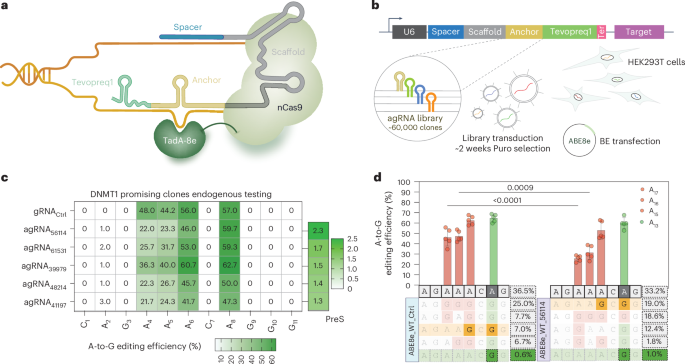
The agRNA library consists of an upstream binding sequence that’s the reverse complement of the downstream sequence of the goal, a counter-loop and a downstream binding sequence that binds the upstream sequence of the goal. The upstream and downstream binding sequences are of various size and have totally different binding areas within the 1–11 bp area upstream and downstream of the goal. The counter-loop library contains 33 totally different DNA sequences of which the longer sequences type GC-rich hairpins. The size of the counter-loop ranges from 1 to 14 nucleotides. The ultimate library incorporates each mixture of the potential upstream binding sequence, counter-loop and downstream binding sequence mixtures. A script to generate the hairpin library for a brand new context might be present in Supplementary Code 1. To facilitate agRNA library design for brand spanking new targets, we developed a Python script (Supplementary Code 1) that routinely generates library sequences tailor-made to any customized base enhancing website.
The agRNA for DNMT1 was ordered as an Agilent DNA Oligo Pool (64,610 oligonucleotides; Supplementary Tables 5 and 6). The oligonucleotides for the DNMT1 library contained a Gibson overhang, gRNA, gRNA scaffold, agRNA library and a terminator adopted by a brief DNA sequence used as primer binding website. The goal for the DNMT1 library was already cloned on the plasmid used as a spine. The DNA Oligo Pool library was amplified by PCR with the oligonucleotides Lib_F and Lib_R utilizing Q5 Sizzling Begin Excessive-Constancy DNA Polymerase (NEB, cat. no. M0493S). The spine pU6-tevopreq1-GG-acceptor (Addgene, cat. no. 174038) was PCR amplified utilizing the oligos SplitF and SplitR. The PCR product of the spine was digested in a single day with DpnI (NEB, cat. no. R0176S) at 37 °C and each PCR merchandise had been purified utilizing the Monarch PCR and DNA Cleanup Equipment (NEB, cat. no. T1130S) in response to the producer’s protocol. The fragments had been assembled utilizing the Gibson Meeting Grasp Combine (NEB, cat. no. E2611S) in a ten:1 ratio library:spine and 150 ng of the spine DNA in response to the producer’s protocol. A 2-µl aliquot of the Gibson meeting combine was used to immediately remodel DUOs electrocompetent cells (Endura, cat. no. 60242-1) and, after restoration on 1 ml of SOC medium, plated on Carbenicillin/Agar plates poured in Nunc Sq. BioAssay Dishes (Cole Palmer, cat. no. EW-01929-00). For cloning into the spine LentiGuide-Puro (Addgene, cat. no. 52963), the library was amplified from the pU6-tevopreq1-GG-acceptor. The spine was digested utilizing PspXI (NEB, cat. no. R0656S) and Esp3I (NEB, cat. no. R0734S) and cloned by Gibson meeting following the beforehand described protocol.
For every library not less than ten instances library protection of colonies had been washed off the plates utilizing LB medium then spun down. The plasmid DNA was extracted from the ensuing pellet utilizing a Plasmid Plus Midi Equipment (Qiagen, cat. no. 12943) in response to the producer’s protocol.
Lentiviral particles technology
HEK293T had been cells had been seeded at a density of 5 × 10⁶ cells per 10-cm plate in DMEM supplemented with 10% FBS and antibiotics (Thermo Fisher, cat. no. 15240062). The next day, cells had been transfected utilizing Transporter 5 Transfection Reagent (Polysciences, cat. no. 26008) with a plasmid combine containing pVSV-G (3.86 µg), pPax2 (8.57 µg) and the lentiviral switch vector (9.23 µg) in Opti-MEM (Thermo Fisher). The DNA-transporter complexes had been incubated at room temperature for 20 min earlier than being added to the tradition medium. After 24 h, the medium was changed with recent DMEM, and viral supernatants had been collected at 48- and 72-h post-transfection. The harvested medium was filtered via a 0.45-µm vacuum filter system and concentrated utilizing Lenti-X Concentrator (Takara Bio, cat. no. 631231) at a 1:3 ratio (media to concentrator) by incubation at 4 °C for not less than 30 min, adopted by centrifugation at 1,500g for 45 min at 4 °C. The viral pellet was resuspended in phosphate-buffered saline, aliquoted and saved at −80 °C till additional use.
DNMT1 library testing in HEK cells
HEK293T cells had been transduced with the lentiviral library with a multiplicity of an infection of 0.2. After 24–48 h, medium was eliminated and exchanged for recent medium with 2 μg ml−1 of Puromycin. Choice continued for two weeks. To check the enhancing sample throughout our library, 20 million cells (300× protection) had been seeded in a 225 mm3 dish and transfected the day after utilizing Lipofectamine 3000 (Invitrogen, cat. no. L3000015) with 20 μg of pCMV-T7-ABE8e-nSpCas9-P2A-EGFP (KAC978) (Addgene, cat. no. 185910). Genomic DNA was collected from cells 5 days after transfection.
Analysis of the anchor library
Effectivity and precision of the BE together with the agRNA had been evaluated utilizing customized R script. The standard of the reads from NGS samples was assessed earlier than additional processing. Variant calling methods had been then utilized to distinctly establish the right edit (conversion of adenine at place 8 to guanine) aside from bystander edits, which encompassed any conversion of the opposite adenines or mixtures involving A8. Samples with anchor sequences yielding fewer than 20 reads had been excluded to make sure robustness within the knowledge evaluation. Moreover, a quantitative rating was devised and calculated utilizing the next system:
$${rm{Rating}}=({rm{ % }}{rm{Excellent}}{rm{Edit}})/({({rm{ % }}{rm{Excellent}}{rm{Edit}}+{rm{ % }}{rm{Bystander}})}^{2})$$
Anchors attaining the very best scores and demonstrating not less than 20% general enhancing effectivity had been additional characterised experimentally (Supplementary Tables 7 and eight).
Context library technology
For the A-to-G BE, ~12,000 totally different gRNAs concentrating on pathogenic related mutations14 had been cloned as a library to check the efficiency of various hairpins and BEs.
The technology of those context libraries differed from the technology of the agRNA, as intensive recombination occasions occurred when the gRNA, gRNA scaffold, agRNA and goal had been launched as one oligonucleotide. To keep away from recombination points, the gRNA and goal with 11 bp upstream and 25 bp downstream of the native genomic context had been cloned as an oligo missing the gRNA scaffold and hairpin. As a substitute of those, the oligo had two outwards-facing BsaI-HF (NEB, cat. no. R3733S) slicing websites with ten randomized base pairs at that place. The DNA Oligo Pool libraries are amplified utilizing PCR with the oligonucleotides Lib_F and Lib_R. The spine sgBbsI (p2Tol-U6-2×BbsI-sgRNA-HygR) (Addgene, cat. no. 71485) was PCR amplified utilizing the oligos BB_R and BB_F. The PCR product of the spine was digested with DpnI in a single day at 37 °C and each PCR merchandise had been purified utilizing the NEB Monarch PCR and DNA Cleanup Equipment in response to the producer’s protocol. The fragments had been assembled utilizing the New England Biolabs Gibson Meeting Grasp Combine in a ten:1 library:spine ratio and 150 ng of the spine DNA in response to the producer’s protocol. A 2-µl aliquot of the Gibson meeting combine was used immediately to rework Lucigen’s Endura Competent Cells and, after restoration, plated on agar plates poured in Nunc Sq. BioAssay Dishes. For every library not less than ten instances library protection of colonies had been washed off the plates utilizing Luria broth medium after which spun down. The plasmid DNA was extracted utilizing the QIAGEN Plasmid Plus Midi Equipment in response to the producer’s protocol from the ensuing pellet.
The library was then digested utilizing BsaI in response to the producer’s protocol and gel purified utilizing the New England Biolabs Monarch Gel Extraction Equipment in response to the Producer’s protocol. The gRNA scaffold, hairpin and terminator with an inward dealing with BsaI slicing website up- and downstream had been ordered as cloned gene synthesis from IDT. The plasmid was additionally BsaI digested, and the fragment was purified utilizing the New England Biolabs Monarch Gel Extraction Equipment in response to the Producer’s protocol. The insert and library had been ligated utilizing New England Biolabs T4 DNA Ligase in response to the Producer’s protocol with 150 ng spine and a ten:1 ratio of the insert to the spine. 2 µl of the ligation combine had been immediately reworked into Lucigen’s Endura Competent Cells and after restoration plated on agar plates poured in Nunc Sq. BioAssay Dishes. For every library not less than 10x library protection of colonies had been washed off the plates utilizing LB medium after which spun down. The plasmid DNA was extracted from the ensuing pellet utilizing the QIAGEN Plasmid Plus Midi Equipment in response to the producer’s protocol.
Path_Var library testing in HEK cells
For steady Tol2 transposon-mediated library integration, 5 million HEK293T cells (~400× protection) had been seeded in 175 mm3 dishes. The next day, cells had been cotransfected utilizing Lipofectamine 3000 with 10 μg of Tol2 transposase plasmid (pCMV-Tol2; Addgene, cat. no. 31823) and 10 μg of Path_Var library. To generate steady library cell traces, cells had been chosen with hygromycin (25 μg ml−1) beginning the day after transfection and continued for two weeks. Thereafter, 2.5 million cells had been transfected with 10 μg of BE utilizing Lipofectamine 3000 to (~200× protection) had been seeded the day earlier than in a 100-mm3 dish. Genomic DNA was collected from cells 5 days after transfection.
Illumina sequencing and bioinformatic evaluation of the libraries
To sequence the libraries earlier than (as high quality management) and after testing within the HEK293T cells, 1 ng of the remoted plasmid DNA (QuickExtract DNA Extraction Answer Biosearch Applied sciences) was amplified utilizing the oligonucleotide combine IllSeq_DNMT1_i5_F1-4 and IllSeq_DNMT1_i7_R1-4 utilizing Q5 Excessive-Constancy 2× Grasp Combine in response to the producer’s protocol. The ahead and reverse oligonucleotide contained an i5/i7 overhang for indexing in addition to 4 to seven Ns to make sure shifting of the sequence to have the ability to decide sequences with excessive identification. The ensuing PCR merchandise had been amplified in a second PCR response utilizing a suitable mixture of the NEBNext Multiplex Oligos for Illumina (NEB, cat. no. E6440S). The PCR merchandise had been purified utilizing the Monarch Gel Extraction Equipment (NEB, cat. no. T1120S) and quantified utilizing Qubit-HS (Invitrogen, cat. no. Q33231). A 4-nM pool of the totally different libraries was generated and 10% 4 nM PhiX was added. The pool was sequenced utilizing the Illumina MiSeq Reagent Equipment v.2 (300 cycles) in response to the producer’s protocol.
Analysis of the context library
Analysis of the context library concerned analyzing gRNA libraries, which comprised roughly 12,000 spacer sequences and their respective contextual sequences. The effectivity and enhancing profiles for every gRNA had been established utilizing customized scripts developed in R. First, the goal websites, the place every spacer binds throughout the context, had been extracted from the NGS reads. Subsequently, for every spacer within the library, all mixtures of adenine to guanine conversions had been aligned in opposition to these extracted sequences. Spacers with fewer than 25 complete reads had been excluded from the evaluation. To quantify general enhancing effectivity for the totally different BEs, the imply A to G conversion price was calculated by averaging the enhancing frequencies at every focused place.
Genome enhancing of endogenous human genomic loci
A complete of 30,000 cells (HEK293T, HeLa and HepG2) had been seeded in 96-well plates (Corning) and transfected the following day utilizing jetOPTIMUS (Sartorius, cat. no. 101000006) or TransIT-X2 (MirusBio, 6003) following the producer directions. Then, 50 ng of sgRNA or agRNA (each cloned in BPK1520; Addgene, cat. no. 65777) with 150 ng of BE variant had been cotransfected, and cells had been harvested after 3 days for Sanger sequencing (Azenta Life Sciences) or NGS (Quintara Biosciences or in-house Illumina miSeq). Cas9-dependent genomic off-target websites, predicted utilizing Cas-OFFinder32, had been analyzed by focused PCR by NGS. Spacer sequences of examined loci are present in Supplementary Desk 9. NGS knowledge had been analyzed utilizing CRISPRESSO33 and BE-analyzer (CRISPR RGEN instruments)33 and consultant substitution tables are present in Supplementary Desk 3. gRNAs utilized in Fig. 4d and Supplementary Figs. 5g, 6b,e,f and 8b had been described beforehand in ref. 34. gRNAs utilized in Supplementary Fig. 6g had been described beforehand in ref. 16. gRNAs utilized in Supplementary Fig. 6b had been described beforehand in ref. 35.
DNA Cas9-independent off-target enhancing evaluation
The evaluation of Cas9-independent off-target evaluation was carried out by R-loop assay following beforehand detailed protocols and gRNAs22; 150 ng of BE (nSpCas9-ABE8e-SpRY or advanced variant), 100 ng of SpCas9 gRNA plasmid, 150 ng of a catalytically lifeless SaCas9 and 100 ng of SaCas9 gRNA plasmid (concentrating on a genomic locus unrelated to the on-target website) had been cotransfected into HEK293T cells. DNA was extracted after 72 h and analyzed utilizing high-throughput sequencing.
RNA sequencing
HEK293T cells had been seeded in 48-well plates and transfected with 300 ng of BE plasmid and 100 ng of gRNA plasmid per properly. After 48 h, cells had been lysed and complete RNA was extracted utilizing TRIzol (Invitrogen, cat. no. 15596026) reagent in response to the producer’s directions. RNA sequencing was carried out by Azenta Life Sciences in response to the next protocol.
For RNA sequencing with poly(A) choice, complete RNA was quantified utilizing a Qubit 2.0 Fluorometer (Life Applied sciences), and RNA integrity was assessed utilizing the Agilent TapeStation 4200 (Agilent Applied sciences). ERCC RNA Spike-In Combine (Thermo Fisher Scientific) was added to normalized RNA samples following the producer’s protocol.
RNA sequencing libraries had been ready utilizing the NEBNext Extremely II RNA Library Prep Equipment for Illumina (NEB, cat. no. E7770S), following the producer’s directions. Briefly, mRNA was enriched utilizing oligo(dT) beads, then fragmented at 94 °C for 15 min. First- and second-strand cDNA synthesis was carried out, adopted by finish restore, 3′ adenylation, adapter ligation, index addition and PCR enrichment. Libraries had been validated utilizing the Agilent TapeStation and quantified utilizing the Qubit 2.0 Fluorometer and quantitative PCR (KAPA Biosystems).
Ready libraries had been multiplexed and sequenced on an Illumina NovaSeq X Plus system (Illumina) utilizing 2 × 150 bp paired-end reads. Picture evaluation and base calling had been carried out utilizing NovaSeq Management Software program (NCS), and uncooked BCL information had been transformed to FASTQ format and demultiplexed utilizing bcl2fastq v.2.20, permitting one mismatch in index sequences.
RNA Cas9-independent off-target enhancing evaluation
To evaluate A-to-I RNA enhancing, SNP and indel calling was carried out utilizing Samtools mpileup (v.1.3.1) adopted by VarScan (v.2.3.9) with the next parameters: –min-coverage 1–min-reads2 1–min-var-freq 0.01–P worth 0.05. Variant name format information from BE-treated samples had been analyzed for A-to-I RNA enhancing occasions utilizing a customized pipeline. Management variants had been collected from three unbiased management samples and merged to generate a complete background set (40,625 variants), which was subtracted from therapy samples to exclude germline or systematic variants.
A-to-G substitutions had been thought of putative A-to-I enhancing websites. Stringent high quality filters had been utilized: minimal learn depth ≥5×, minimal allele frequency ≥1% and most allele frequency ≤99% (to take away homozygous SNPs). After background subtraction, high-confidence A-to-I enhancing websites had been retained. Enhancing percentages had been calculated per website because the ratio of edited reads to complete reads (AD/DP within the variant name format) and per pattern as the common enhancing frequency throughout all websites passing filters.
Utilizing this strategy, we recognized 207,541 high-confidence A-to-I enhancing websites throughout 12 samples (ABE8e-SpRY, V28C-SpRY and L34W-SpRY BEs with sgRNACtrl or agRNA56114, every in duplicate).
Era of the choice phages for PANCE
The PANCE choice phages are carrying the CDS for the ABE8e adenine deaminase as a substitute of the CDS of PIII. The ABE8e adenine deaminase has a part of the peptide linker sequence and a C-terminal fused intein CDS to allow it to encode the comparatively small protein and never the entire BE. The phages had been generated by PCR amplifying the ABE8e adenine deaminase together with the partial sequence of the peptide linker utilizing the oligonucleotides ABE_M13_F and ABE_M13_R. The N-terminal Npu DnaE intein was ordered as gBlock and amplified utilizing the oligonucleotides Npu_ABE_F and Npu_M13_R. The phage spine was amplified utilizing the oligonucleotides GOI_M13_F and GOI_M13_R utilizing M13KO7 helper phage (NEB, cat. no. N0315S) genomic DNA as a template. All PCRs had been carried out utilizing Q5 Excessive-Constancy 2× Grasp Combine in response to the producer’s protocol utilizing 1 ng of template DNA and an annealing temperature of 60 °C. All fragments had been digested with DpnI (NEB) in a single day at 37 °C within the PCR buffer and PCR purified utilizing the NEB Monarch PCR and DNA Cleanup Equipment the following day. The fragments had been assembled utilizing the NEB Gibson Meeting Grasp Combine in response to the producer’s protocol and three µl of the response had been reworked immediately into electrocompetent S2060 pJC175e competent cells. The cells had been recovered in 500 µl SOC medium for 45 min, then 450 µl and 50 µl had been every combined with 500 µl freshly grown S2060 pJC175e cells. The cells had been combined instantly with 3 ml smooth LB agar (0.7%) and plated on LB backside agar plates containing 100 µg ml−1 carbenicillin. The plates had been incubated at 37 °C in a single day. Plaques had been picked into 50 µl 2× YT medium and 1 µl was used as a template for colony PCR utilizing the oligonucleotides ABE_M13_F and Npu_M13_R. Constructive phages had been amplified by including the remaining 2× YT medium to a freshly grown S2060 pJC175e tradition on the OD600 of 0.4 and cultivating for 16 h at 37 °C. The cultures had been spun all the way down to take away the Escherichia coli cells and the phages had been precipitated by including a 20% polyethylene glycol (8000) and a pair of.5 M sodium chloride answer in a 1:4 ratio to the tradition supernatant. The combination is incubated for not less than 3 h at 4 °C and the phage pellet is resuspended in a phosphate-buffered saline buffer, the phage titer was quantified utilizing the Phage Titration ELISA equipment (Progen, PRPHAGE) and the phages had been saved at 4 °C till use. Moreover, 3 ml of the tradition supernatant was used for phage DNA isolation utilizing the E.Z.N.A. M13 DNA Mini equipment (Omega Bio-tek, cat. no. D6900-01). The remoted DNA was despatched to Plasmidsaurus for whole-phage DNA sequencing.
Era of the choice cells for PANCE
The choice plasmids had been designed on the idea of utilizing pJC175e (Addgene, cat. no. 79219)36 and including mutations that, when edited by the ABE, solely good edits restore PIII exercise whereas bystander edits decrease pIII exercise. The pJC175e spine was amplified utilizing the oligonucleotides pIII_gBlock_R and pJC175e_Cas_F. The a part of the pIII CDS containing the mutation adopted by the corresponding information correcting the launched mutation downstream in addition to the C-terminal DnaE intein essential to fuse the ABE8e encoded by the phage to the nSpCas9-SpRY encoded by the choice plasmid had been ordered as gBlock. Every choice plasmid additionally encodes the agRNA to repair the mutation on pIII (Supplementary Desk 8). The three totally different gBlocks for the three totally different choice plasmids every encoding a distinct pIII mutation had been amplified by PCR utilizing the oligonucleotides gBlock_R and gBlock_pIII_F. The bottom nSpCas9 CDS was amplified from ABE8e plasmid (Addgene, cat. no. 138489) utilizing the oligonucleotides BE_Npu_F and BE_pJC175e_R. All PCRs had been carried out utilizing Q5 Excessive-Constancy 2× Grasp Combine in response to the producer’s protocol utilizing 1 ng of template DNA and an annealing temperature of 60 °C. All fragments had been digested with DpnI in a single day at 37 °C within the PCR buffer and PCR purified utilizing the NEB Monarch PCR and DNA Cleanup equipment the following day. The fragments had been assembled utilizing the NEB Gibson Meeting Grasp Combine in response to the producer’s protocol and reworked into electrocompetent S2060 competent cells. The cells had been recovered in 500 µl SOC medium for 1 h then plated on LB agar plates with 100 µg ml−1 carbenicillin and incubated in a single day at 37 °C. Colonies had been screened utilizing colony PCR and constructive clones had been despatched for whole-plasmid sequencing. Clones with verified sequence had been used to generate electrocompetent cells that had been then reworked with the mutation plasmid MP4 (Addgene, cat. no. 69652)37. The cells had been recovered in 1 ml SOC medium and plated on 2× YT agar plates containing 1% glucose, 100 µg ml−1 carbenicillin and 25 µg ml−1 chloramphenicol. 5 colonies had been used to start out 50-µl shake flask 2× YT 1% glucose, 100 µg ml−1 carbenicillin and 25 µg ml−1 chloramphenicol cultivations. The cultivations had been used to freeze 20% glycerol shares in 1 ml aliquots after 16 h. Every tradition was additionally used to isolate plasmid DNA for whole-plasmid sequencing by Plasmidsaurus to pick out the glycerol shares with no mutation in MP4 and the choice plasmid.
PANCE
The evolution was carried out as ten consecutive batch cultivations in triplicate utilizing a mixture of three totally different choice plasmids in every evolution. For the PANCE experiment, the day earlier than the cultivation, three 3-ml in a single day cultures had been ready utilizing 2× YT medium with 1% glucose, 100 µg ml−1 carbenicillin and 25 µg ml−1 chloramphenicol. The cultures are inoculated with the glycerol inventory of one of many choice plasmids every. The next day, 3–4 h earlier than phage an infection, 50-ml shake flasks are inoculated with a mixed OD600 of 0.1 of the pooled in a single day cultures with the totally different choice plasmids. The cells are cultivated in 2× YT with 100 µg ml−1 carbenicillin and 25 µg ml−1 chloramphenicol. At 30 min earlier than reaching an OD600 of 0.4, the cells are induced with 0.5% arabinose and when the cells attain the OD600 of 0.4, the cells are contaminated with the choice phages at a multiplicity of an infection of 1 for the primary choice spherical. The evolution is carried out for 12 h at 37 °C; thereafter, the whole cultivation was spun down and the supernatant was filtered with 0.2 µM filters. For choice rounds 2–4, 500 µl, for rounds 5–6 100 µl and for the remaining rounds 5 µl of the supernatant had been used to contaminate the next evolution. The phage titer after every choice spherical was decided utilizing the Progen Phage Titration ELISA equipment. A 3-ml aliquot of every tradition supernatant was used for phage DNA isolation utilizing the Omega Bio-tek E.Z.N.A. M13 DNA Mini Equipment. Sequences of V28C, L34W, M151E and V28C-M151E are detailed in Supplementary Desk 8.
Illumina sequencing of the PANCE experiment
To sequence the PANCE variants, 1 ng of the remoted plasmid phage DNA of every choice spherical was amplified utilizing the oligonucleotide combine IllSeq_ABE_i5_F1-4 and IllSeq_ABE_i5_R1-4 utilizing Q5 Excessive-Constancy 2× Grasp Combine in response to the producer’s protocol. The ahead and reverse oligonucleotide contained an i5/i7 overhang for indexing in addition to 4 to seven Ns to make sure shifting of the sequence to have the ability to decide sequences with excessive identification. The ensuing PCR merchandise had been amplified in a second PCR response utilizing a suitable mixture of the NEBNext Multiplex Oligos for Illumina. The PCR merchandise had been purified utilizing the Monarch Gel Extraction Equipment and quantified utilizing Qubit-HS. A 4-nM pool of the totally different libraries was generated and 10% 4 nM PhiX was added. The pool was sequenced utilizing the MiSeq Reagent Equipment v.3 (600-cycles, Illumina, MS-102-3003) in response to the producer’s protocol.
PreS calculation
To quantify the specificity and effectivity of every variant in enhancing the goal nucleotide with minimal bystander exercise, we outlined a PreS utilizing the next system:
$$start{array}{rcl}start{array}{l}{rm{PreS}}=({rm{ % }}displaystyle frac{{rm{On}},{rm{goal}},{rm{enhancing}}}{{rm{Common}},{rm{bystander}},{rm{enhancing}}}) ,instances ({rm{ % }}displaystyle frac{{rm{On}},{rm{goal}},{rm{enhancing}},({rm{variant}})}{{rm{On}},{rm{goal}},{rm{enhancing}},({rm{ABE}}8{rm{eCtrl}})})finish{array}finish{array}$$
This rating integrates two key parts:
Enhancing precision because the ratio of on-target enhancing to common bystander enhancing. This displays the precision of enhancing on the meant nucleotide relative to unintended close by edits.
Relative effectivity because the comparability of a variant’s on-target enhancing effectivity to that of ABE8e—our reference editor. This normalization controls for variations in baseline enhancing effectivity and permits comparability throughout variants.
A better PreS signifies a variant that edits the meant base with excessive effectivity and minimal bystander exercise relative to ABE8e. For instance, ABE8e-SpRYCtrl has a PreS of 0.8 on the DNMT1 website. The ultimate worth was calculated by dividing the enhancing effectivity at place A8 (15.3%) by the whole bystander enhancing at positions A4, A5 and A6 (19%), and multiplying by a normalization issue derived from the ratio of enhancing at A8 to itself (15.3%/15.3%), which simplifies to 1. All PreS above 0.8 point out increased precision and or exercise.
Evolutionary believable mutations prediction with ML
We adopted the strategy utilized by Hie et al.23, which consists of utilizing an ensemble of six PLMs: ESM-1b23 and ESM-1v24, composed itself of 5 fashions (accessible at: Collectively, the six fashions are used to foretell what amino acids, if any, could be extra probably than the present wild-type amino acid at every place of the protein sequence given as enter. The variety of fashions within the ensemble agreeing on a given prediction (that’s, a selected amino acid substitution) permits to attain a given substitution, the place the next rating is extra more likely to yield a constructive consequence.
We utilized the ensemble of PLMs to the TadA-8e sequence, which yielded the next predictions (PreS in parenthesis): R26G (6), F84L (6), N108D (6), Y149F (6), F156K (6), V106A (5), P152R (5), H8D (5), N157K (5), R111T (4), C146S (3), R111A (2), C146Q (2), M151E (2), C146K (1), Y123H (1), M151Q (1), A48P (1), V155E (1), S109P (1), P152Q (1).
Computational evaluation of structural impression on ABE8e
We used the crystal construction of ABE8e named 6vpc out there within the Protein Information Financial institution database and the software program ChimeraX (v.1.6.1 (9 Could 2023) for visualization and evaluation of the construction.
We first tried to foretell the constructions of related mutants on this research utilizing AlphaFold2 (out there within the colab pocket book from sokrypton). Nonetheless, no structural change was predicted for these single or double mutants with AlphaFold2, which agrees with earlier observations on the constraints of AlphaFold2. As well as, a area related to this research involving residues from 151 to 160 of chain F was folded incorrectly by AlphaFold2. Therefore, we determined to immediately mutate our goal residues on the crystal construction of ABE8e, though this assumes there is no such thing as a conformational or folding change for our mutants.
Utilizing the command line in ChimeraX, we visualized, mutated and analyzed interactions of goal residues. We additionally analyzed interactions of nucleotides 5 to eight within the gRNA with residues of ABE8e. We searched for hydrogen bonds, nonpolar (van der Waals) interactions between carbon atoms within the gRNA and protein at a most distance of three.8 Å, and cationic interactions between nitrogen atoms inside 5 Å of an fragrant carbon involving our goal residues and nucleotides.
Enhancing of iPS cells
Plasmid nucleofection was carried out utilizing the Neon Electroporation System (Thermo Fisher) 10 μl equipment. A complete of 200,000 cells had been resuspended in ~10 μl of buffer R and combined with 200 ng of gRNA vector and 200 μg of BE. Nucleofection was carried out utilizing the next parameters: voltage, 1,400 V; width, 20 ms; pulses, two pulses. After nucleofection, cells had been plated in 12-well plates with 400 μl of StemFlex medium (Gibco, cat. no. A3349401) with out antibiotic and 1:100 dilution of RevitaCell Complement (Gibco, cat. no. A26445-01). After 24 h, the medium was changed and enhancing was evaluated after 48 h by NGS (Quintara Biosciences). gRNAs had been generated for this research.
Statistics and reproducibility
No statistical strategies had been used to predetermine pattern measurement. Pattern sizes had been chosen based mostly on requirements from earlier genome enhancing research and had been enough to make sure reproducibility. For cell-based and sequencing experiments, three to 6 unbiased replicates had been carried out, which reliably captured organic variability and produced constant impact sizes throughout experiments.
All experiments had been carried out independently not less than 3 times, until in any other case said. Statistical analyses and plots had been generated utilizing GraphPad Prism v.10 (GraphPad Software program LLC). Two-tailed, unpaired Pupil’s t-tests, one-way and two-way evaluation of variance (ANOVA) had been used to judge variations between teams, with P < 0.05 thought of statistically vital. In instances the place including P values on to the figures would compromise visible readability, the corresponding statistical comparisons are offered in Supplementary Desk 10.
Reporting abstract
Additional data on analysis design is on the market within the Nature Portfolio Reporting Abstract linked to this text.








Leave a Reply