
Wish to bookmark your favorite articles and tales to learn or reference later? Begin your Impartial Membership at this time.
Be a part of at this time
Already a member?
Log in
A necklace of not less than 24 tiny charms, given to Roman kids as a protecting amulet, was among the many finds from a picket cabinet sealed for nearly 2,000 years in Pompeii.
The cabinet, reconstructed by archaeologists from traces present in a home on By way of dell’Abbondanza, one of many busiest streets of historical Pompeii, has produced an intimate image of 1 resident’s life earlier than town’s destruction.
In a press release, the location mentioned the objects ranged from make-up utensils and fragrance to cash, cooking pots and childhood amulets.
Mount Vesuvius buried the once-thriving metropolis, close to Naples, beneath metres of ash in a volcanic eruption in AD 79.
An enormous variety of buildings, objects and graffiti have been preserved by that ash.
Within the case of this cabinet, archaeologists have been in a position to piece it collectively from fragments and traces found inside the home.

“We can’t reconstruct with certainty the id of whoever lived in the home, however these fragments carry us nearer to their each day life,” web site director Gabriel Zuchtriegel informed Reuters.
The necklace’s tiny objects have been made up of bone, glass paste, earthenware and rock crystal.
They included photos of the gods Bes and Mercury, in addition to miniature arms, toes, pine cones and bunches of grapes.
Necklaces of this sort have been generally known as crepundia, and have been historically given to Roman kids each as protecting amulets and as rattles whose sounds helped adults hold observe of them.
Such necklaces have been generally saved into maturity as mementos of childhood, providing a very private connection to the unknown inhabitant of the home.
Fragrance, cash and mice
Different finds, together with tweezers, a small glass fragrance or ointment bottle and an incense burner, inform a extra prosaic story of each day life.
Bronze, glass and ceramic vessels and cooking pots had additionally been saved within the cabinet.
Lead weights in a picket field advised that somebody in the home was concerned in commerce, and a small woven container held 38 bronze cash.
The truth that each cash and objects with obvious sentimental worth remained behind suggests the homeowners had no time to retrieve them after Vesuvius erupted.
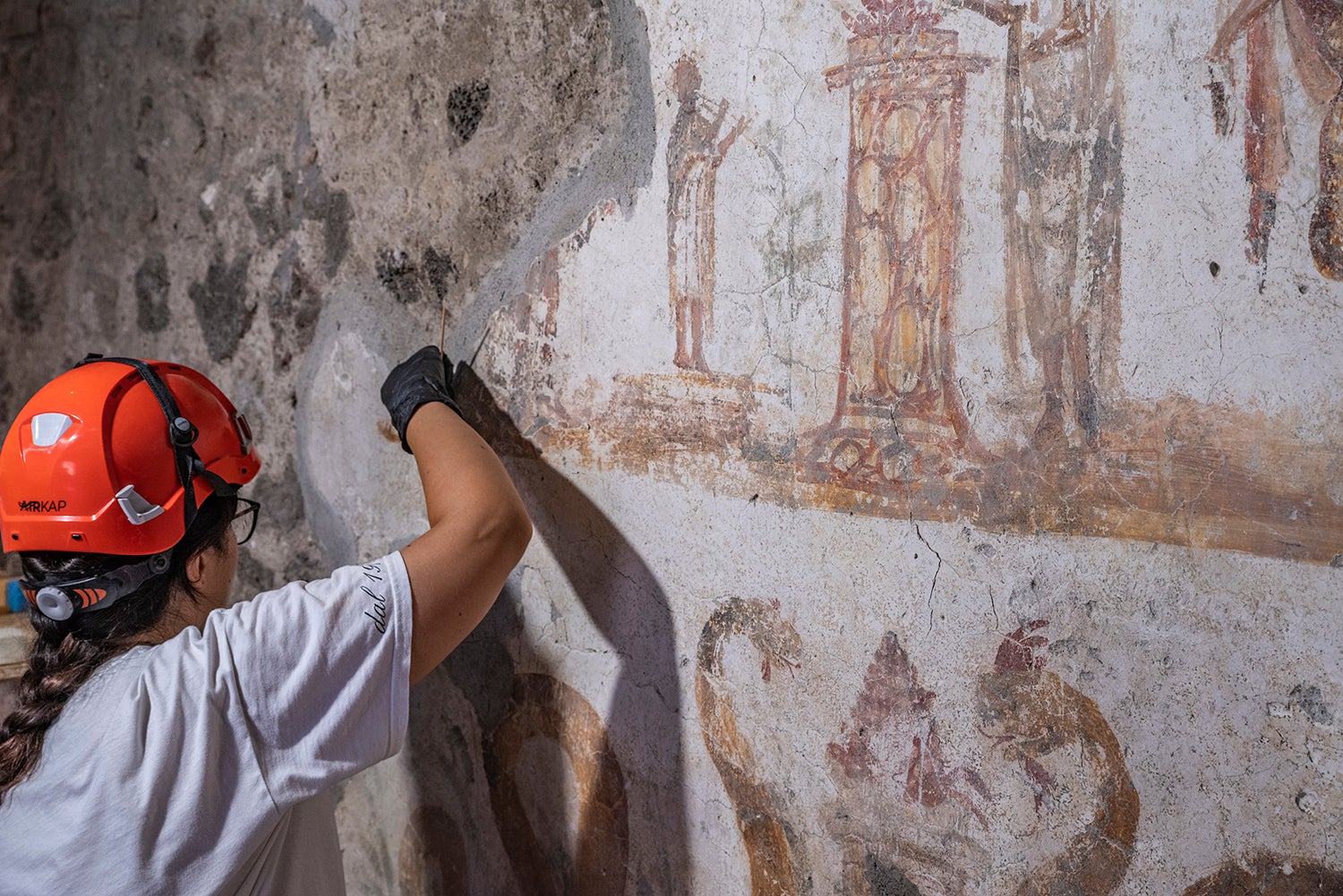
“Pompeii isn’t just a spot of nice artworks. Additionally it is a spot the place essentially the most bizarre objects restore the human dimension of the previous,” Zuchtriegel mentioned.
“The worth of this discovery lies in the potential for studying collectively the totally different traces of a life: private habits, work and reminiscences.”
The home sits in a central space of Pompeii, and has been tentatively related to a person named Cornelius Maximus due to inscriptions found there.
Its facade was first excavated in 1912, however archaeologists have solely now investigated among the rooms behind it as a part of a wider restoration venture.
The excavation additionally offered proof that some issues of city dwelling have modified remarkably little in two millennia.